
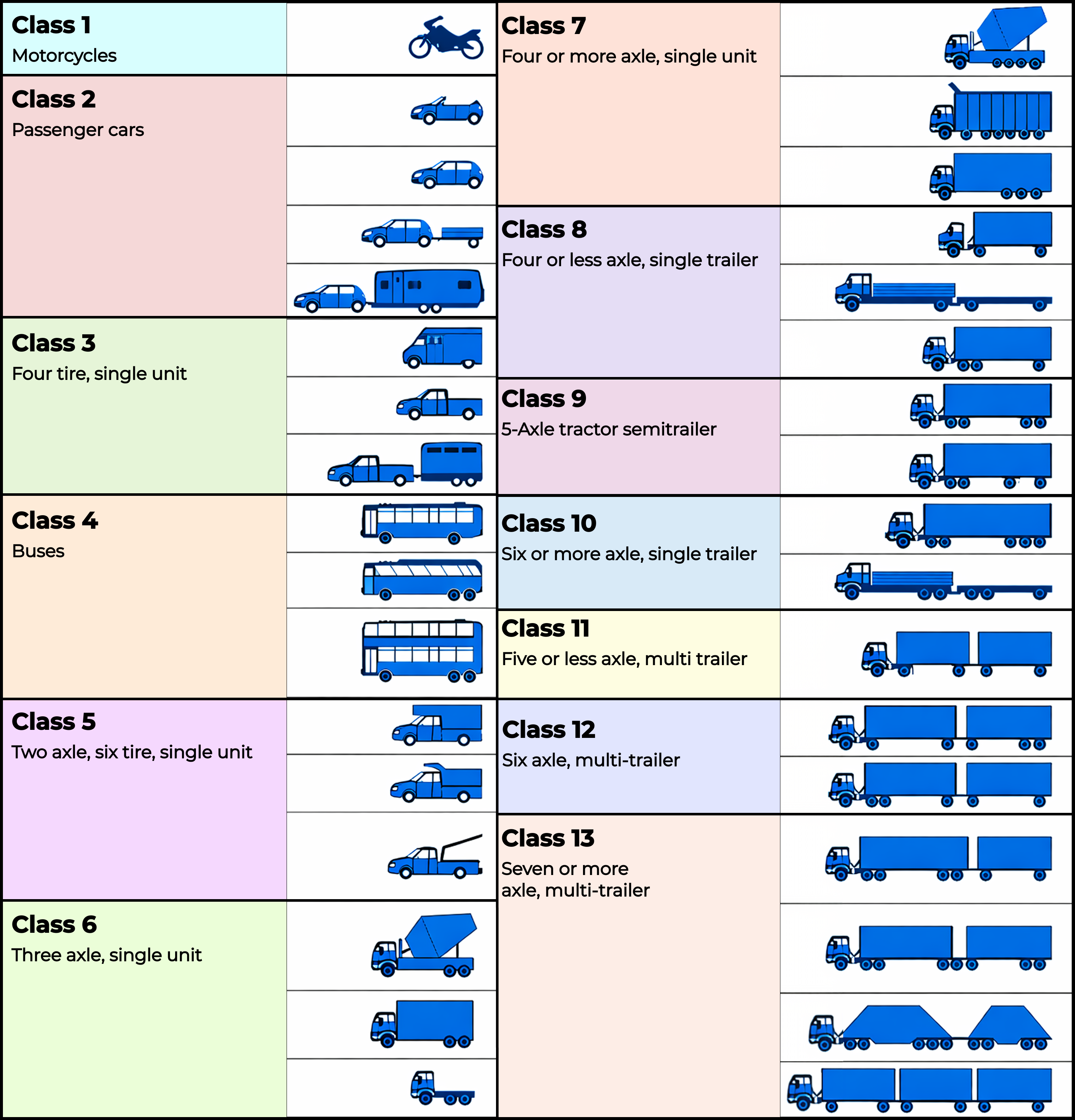
Figure A.
Why Vehicle Classification Matters
Understanding the types of vehicles on the road is essential for effective transportation planning and infrastructure design. Accurate classification data informs pavement thickness and material selection. It’s also used in the FHWA’s Long-Term Pavement Performance, also known as the LTPP program, which studies how traffic loads impact pavement durability over time.
Vehicle classification also plays a key role in freight route planning by identifying high-volume truck corridors and improving commercial traffic management. It enhances safety modeling by highlighting risks associated with different vehicle types during peak periods and ensures maintenance funding is distributed based on actual road usage.
Overview of the FHWA Classification System
The FHWA classification rule set ranges from motorcycles to large multi-trailer trucks. These categories are outlined in the FHWA's Traffic Monitoring Guide (TMG), which provides the methodology for consistent classification and reporting across states. Each class reflects a commonly observed vehicle configuration on U.S. roads.
FHWA Vehicle Categories:
- Class 1: Motorcycles (two-or three-wheeled vehicles)
- Classes 2–3: Passenger cars and light trucks (sedans, pickups, vans)
- Classes 4–7: Buses and single-unit trucks (transit buses, box trucks)
- Classes 8–13: Multi-unit trucks and trailers (tractor-trailers, double trailers)
| Class Group | Class Definition | Class Includes | Number of Axles |
| 1 | Motorcycles | Motorcycles | 2 |
| 2 | Passenger Cars | All cars Cars with one-axle trailers Cars with two-axle trailers | 2, 3, or 4 |
| 3 | Other Two-Axle Four-Tire Single-Unit Vehicles | Pick-ups and vans Pick-ups and vans with one- and two-axle trailers | 2, 3, or 4 |
| 4 | Buses | Two- and three-axle buses | 2 or 3 |
| 5 | Two-Axle, Six-Tire, Single-Unit Trucks | Two-axle trucks | 2 |
| 6 | Three-Axle Single-Unit Trucks | Three-axle trucks Three-axle tractors without trailers | 3 |
| 7 | Four or More Axle Single-Unit Trucks | Four-, five-, six- and seven-axle single-unit trucks | 4 or more |
| 8 | Four or Fewer Axle Single-Trailer Trucks | Two-axle trucks pulling one- and two-axle trailers Two-axle tractors pulling one- and two-axle trailers Three-axle tractors pulling one-axle trailers | 3 or 4 |
| 9 | Five-Axle Single-Trailer Trucks | Two-axle tractors pulling three-axle trailers Three-axle tractors pulling two-axle trailers Three-axle trucks pulling two-axle trailers | 5 |
| 10 | Six or More Axle Single-Trailer Trucks | Multiple configurations | 6 or more |
| 11 | Five or Fewer Axle Multi-Trailer Trucks | Multiple configurations | 4 or 5 |
| 12 | Six-Axle Multi-Trailer Trucks | Multiple configurations | 6 |
| 13 | Seven or More Axle Multi-Trailer Trucks | Multiple configurations | 7 or more |
Truck Classification Rules
Vehicle classification is based on key physical characteristics, including the number of axles, trailer configuration, and unit type. Axle count directly affects how weight is distributed across the pavement, influencing design and maintenance strategies. Trailer configuration determines whether a vehicle is classified as a single or multi-unit, and unit type refers to whether the vehicle is a self-contained unit, a tractor, or a truck pulling one or more trailers.
Additional classification guidelines include:
- Truck tractor units traveling without a trailer are considered single-unit trucks.
- Truck tractor units pulling others in a saddle mount configuration are also treated as single-unit trucks, defined solely by the axles on the pulling unit.
- Axles are only counted if in contact with the road. Floating axles are included only when in the down (engaged) position.
- The term "trailer" includes both semi-trailers and full trailers.
How to Count Axles on a Truck
Determining the number of axles on a vehicle is straightforward. Each axle supports a pair of wheels and can be found on both the power unit and any trailers being pulled. Accurately counting axles is critical for applying the correct vehicle classification, as axle count influences how a vehicle interacts with the road surface, especially in terms of weight distribution and wear.
FHWA Functional Classification
In addition to vehicle classification, the FHWA also provides a functional classification system for roads. This system categorizes roads based on the type of service they offer, such as long-distance travel or local access. Arterial roads support higher speeds and volumes, collectors serve to connect local roads to arterials, and local roads primarily offer access to homes and businesses.
Understanding a road's functional classification helps planners design appropriate infrastructure, prioritize upgrades, and manage traffic flow efficiently. It also informs pavement design by forecasting the types and volumes of vehicles expected on different road types.
MetroCount’s Role in Classification
MetroCount offers advanced traffic monitoring systems that use axle spacing measurements to classify vehicles according to FHWA standards. ATLYST, our vehicle traffic data software platform processes real-time traffic data, capturing vehicle class, axle configuration, and load distribution. This ensures reliable, high-accuracy data collection which meets the FHWA requirement of ±5% classification accuracy.
Our solutions help transportation agencies monitor long-term traffic trends, submit standard-compliant reports, and make informed infrastructure decisions. Whether you're assessing daily volumes, planning upgrades, or fulfilling federal reporting obligations, MetroCount systems offer the insights you need.
Applications of Truck Classification Data
Truck classification data is used extensively in freight planning, helping identify key commercial routes and optimize logistics. It also informs pavement design models by correlating vehicle loads to expected road wear. Safety and risk analyses depend on understanding when and where heavy vehicles are most active.
In economic evaluations, classification data provides insights into freight efficiency and road usage trends. Agencies use this information to justify infrastructure investments, manage seasonal changes in traffic, and address route-specific challenges. Variables like peak and off-peak volumes, axle weights, and geographic distribution all contribute to a comprehensive understanding of road usage.
FHWA Reporting Requirements
To meet federal reporting standards, transportation agencies must collect and submit classification data using certified vehicle data classification equipment. These systems must capture data in the standardized formats required by the FHWA, including annual reports detailing vehicle class distributions and axle weights.
Meeting these requirements ensures continued eligibility for federal transportation funding and supports transparency in infrastructure planning.
Implementation Guidelines for Agencies
Implementing FHWA classification standards requires more than just equipment. Agencies must ensure staff are trained on the Traffic Monitoring Guide (TMG) procedures and follow regular calibration schedules to maintain data accuracy. Automated workflows for data processing and reporting further streamline compliance.
Using certified, reliable equipment and maintaining best practices in data management ensures that agencies can trust their traffic data when making critical planning decisions.
FAQ
What is a 2-axle vehicle?
A vehicle with two axles typically has one at the front and one at the rear, supporting four wheels in total.
What is a Class 8 truck?
This refers to a single-trailer truck with four or fewer axles, commonly used for regional freight.
What is considered a light truck?
Light trucks generally fall under Classes 2 and 3, including pickups, SUVs, and small vans.
What counts as a vehicle?
A vehicle includes any motorized unit that operates on public roads, including cars, motorcycles, trucks, and trailers.
What is vehicle type?
Vehicle type refers to the category that defines the vehicle’s build, purpose, and configuration.
How many axles does a motorcycle have?
Most motorcycles have two axles, one supporting the front wheel and one supporting the rear.
Got a great MetroCount story? Share it with us and let the world know the great work you're doing in your community.